Thursday, 13 June 2013

FUNCTIONS OF OPERATING SYSTEM

FUNCTIONS OF OPERATING SYSTEM:
                 Operating system functions include managing the hardware and software in a device such as a computer or phone.Operating System Also Known as the Resource Manager.
                
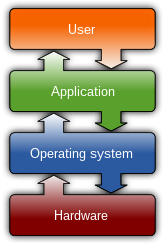
There are Many Functions those are Performed by the Operating System But the Main Goal of Operating System is to Provide the Interface between the user and the hardware Means Provides the Interface for Working on the System by the user

    MAJOR FUNCTIONS OF OPERATING SYSTEM:
             
 he major functions of an OS are:

-resource management,
-data management,
-job (task) management, and
-standard means of communication between user and computer.
 The resource management function of an OS allocates computer resources such as CPU time, main memory, secondary storage, and input and output devices for use.

The data management functions of an OS govern the input and output of the data and their location, storage, and retrieval.

The job management function of an OS prepares, schedules, controls, and monitors jobs submitted for execution to ensure the most efficient processing. A job is a collection of one or more related programs and their data.

The OS establishes a standard means of communication between users and their computer systems. It does this by providing a user interface and a standard set of commands that control the hardware.

operating systems

OPERATING SYSTEM
     An operating system is a collection of software that manages computer hardware resources and provide common services for computer programs.Operating system is the interface between user and the computer hardware.
As the operating system evolved, it moved away from the legacy Mac OS to an ... Previous Macintosh operating systems were named using Arabic numerals, e.g. ...
The operating system controls your computer's tasks and manages system resources to optimize     performance.   


TYPES OF OPERATING SYSTEMS:
types of operating systems are gui,multi-user,multiprocessor,multitasking and multithreading.
 
 GUI - Short for Graphical User Interface, a GUI Operating System contains graphics and icons and is commonly navigated by using a computer mouse. See the GUI definition for a complete definition. Below are some examples of GUI Operating Systems.
Multi-user - A multi-user operating system allows for multiple users to use the same computer at the same time and different times. See the multi-user definition for a complete definition for a complete definition. Below are some examples of multi-user operating systems.
Multiprocessing - An operating system capable of supporting and utilizing more than one computer processor. Below are some examples of multiprocessing operating systems.
Multitasking - An operating system that is capable of allowing multiple software processes to run at the same time. Below are some examples of multitasking operating systems.
Multithreading - Operating systems that allow different parts of a software program to run concurrently. Operating systems that would fall into this category are:
 
The term memory hierarchy is used in computer architecture when discussing performance issues in computer architectural design, algorithm predictions                                               LEVELS OF MEMORY HIERARCHY                                                                          
              there are five levels in memory hierarchy namly level0-registers in cpu,level1-cache,level2-main memory,level3-disk storage and level4-tape units.from level0 to level 4 cost per bit increases, and capacity and access time decreases.
 
Two important levels of the memory hierarchy are the cache and virtual memory.
To evaluate the effectiveness of the memory hierarchy we can use the formula:
      Memory_stall_cycles =  IC * Mem_Refs * Miss_Rate * Miss_Penalty
         where       IC                       = Instruction count
                        Mem_Refs           = Memory References per Instruction
                        Miss_Rate            =  the fraction of accesses that are not in the cache
                        Miss_Penalty       =  the additional time to service the miss